M&A strategy work
The strategy side of corporate development: which targets fit, what has to be true for a deal to work, how it should be structured, and how it gets integrated. Four examples, by type.
My part was the strategy. Valuation models were run by Corporate Development with bankers, and my role was the growth, synergy and positioning inputs that drive them.
Most of this is in-house work from over twelve years at PIMCO and Kraft Heinz, written up by type. Company names, deal names and figures are left out. The images are illustrative samples built from public sources, or screens from a research platform I built. Each one is labelled.
01 · In-house, M&A and Global Strategy, 2022–2026
Screening a wide field down to a short list
The situation
A growth plan had gaps in the portfolio, and there were far more possible targets than anyone could look at closely.
What I did
I set up a data-driven way to find and rank targets against the growth plan, built relationships with founders, and tracked their companies to growth thresholds so the company could move early.
What came of it
A prioritized pipeline of targets tied to the growth plan, and a place at the front of the line, often ahead of any sale process.
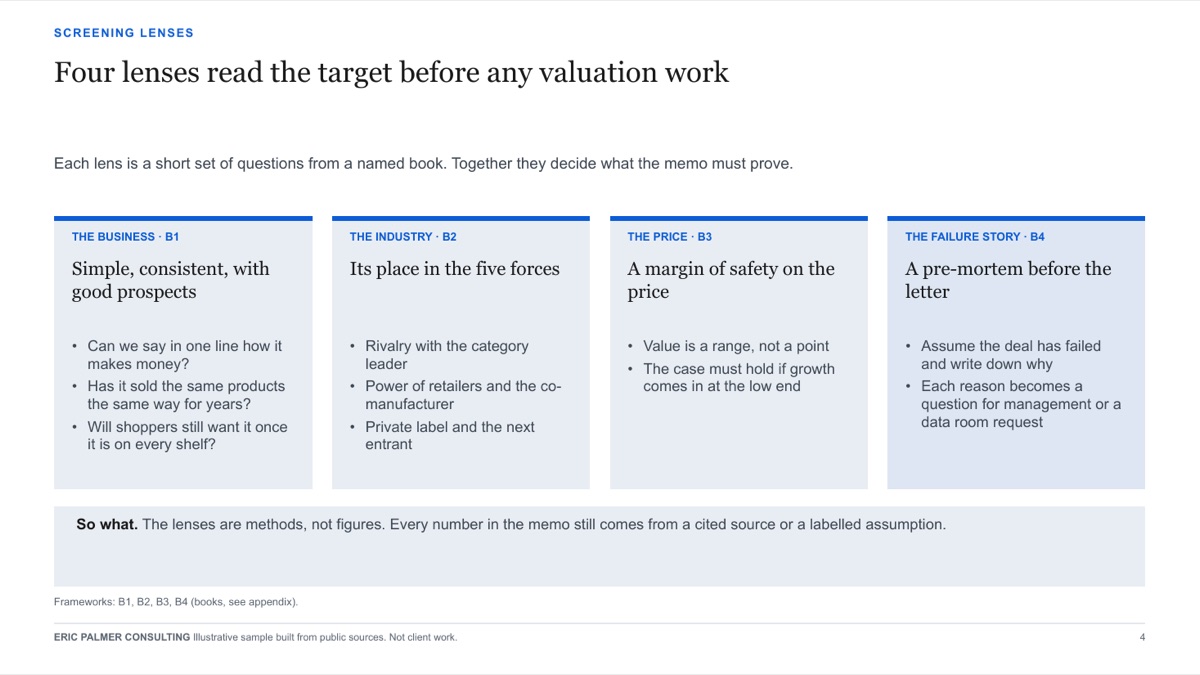
See a sample scope (PDF, 10 pages) →
Illustrative sample, built from public sources for a hypothetical company. Not client work.
02 · In-house, M&A Strategy and Partnerships, 2022–2024
The strategic inputs behind diligence
The situation
Each serious target needed a recommendation to an investment committee, buy, build or partner, along with a view of the price at which the deal stopped making sense for the company.
What I did
I ran diligence, including meeting management in person, and owned the growth, synergy and positioning assumptions behind Corporate Development's valuation models. I took buy, build and partner recommendations to the North America Investment Committee.
What came of it
Executive alignment on the targets worth pursuing. On one large cross-border target, it informed the decision not to proceed at that valuation. Walking away from a full price is a result too.
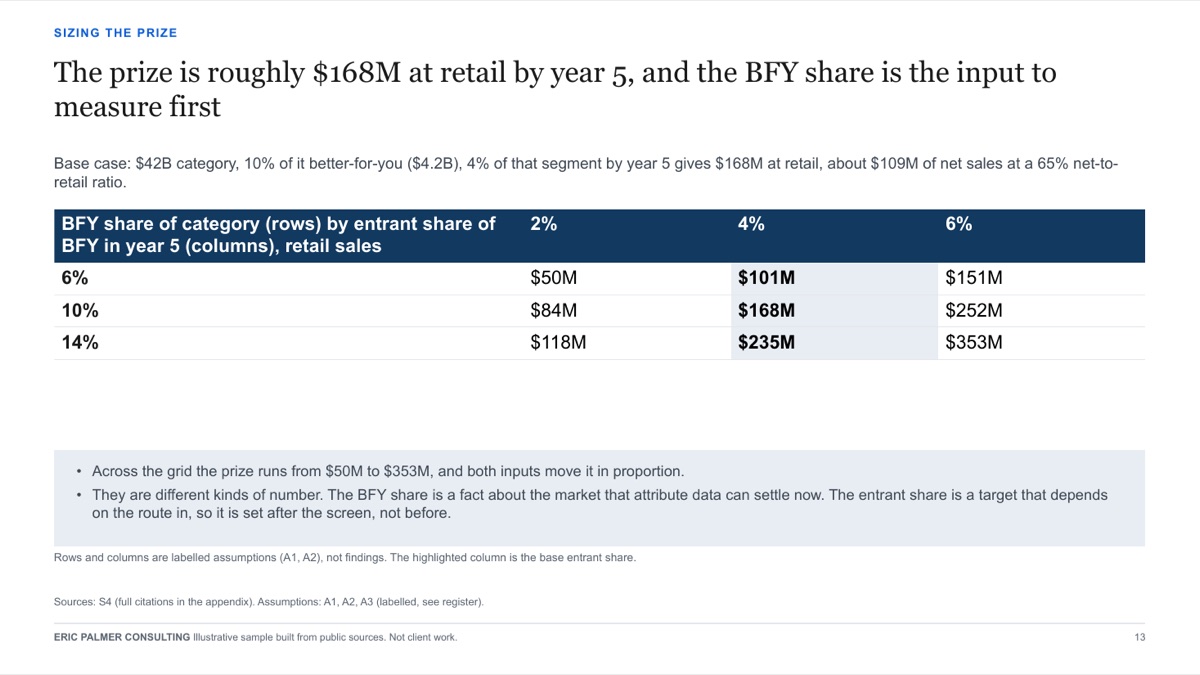
See a sample assessment (PDF, 19 pages) →
Illustrative sample, built from public sources for a hypothetical company. Not client work.
03 · In-house, M&A Strategy and Partnerships, 2022–2024
Choosing the structure, not only the target
The situation
Not every deal should be a full acquisition. Some worked better as a partnership or a joint venture, and one route into a new category ran through a much larger brand.
What I did
I recommended deal structures to the executive team each quarter, a joint venture against a full acquisition for example. I also identified, structured and executed a strategic partnership with a large brand to enter a new product category.
What came of it
The partnership took the company into the new category and added substantial new sales in its first year.
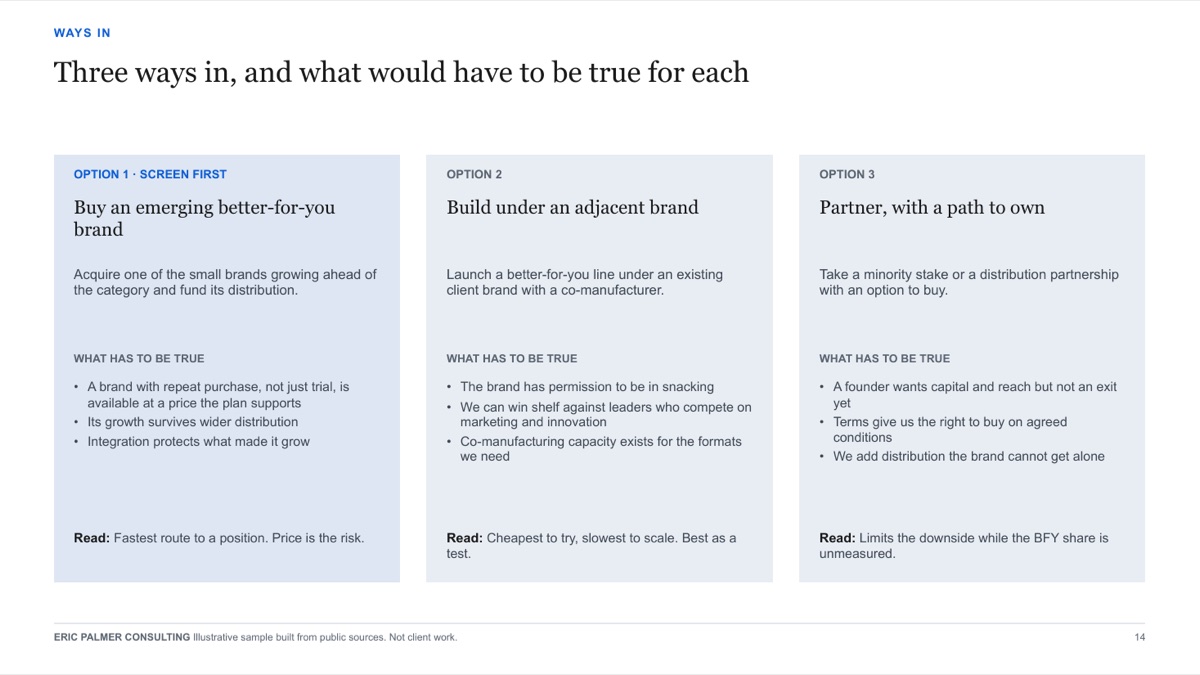
See a sample assessment (PDF, 19 pages) →
Illustrative sample, built from public sources for a hypothetical company. Not client work.
04 · In-house, brand team then M&A, 2018–2024
Integration planned as part of the deal
The situation
A large food company bought a founder-led, fast-growing brand. The value was in the growth, so the integration had to bring the brand into the company without breaking what made it work.
What I did
I worked on the deal from the accelerator team, then was one of two people sent to integrate and grow the brand. I designed and executed the post-acquisition integration strategy and was part of the team that led the ERP integration. Later, in M&A, I worked on M&A integration playbooks.
What came of it
Distribution, manufacturing, technology and sales synergies came through, and the brand more than doubled over three years.
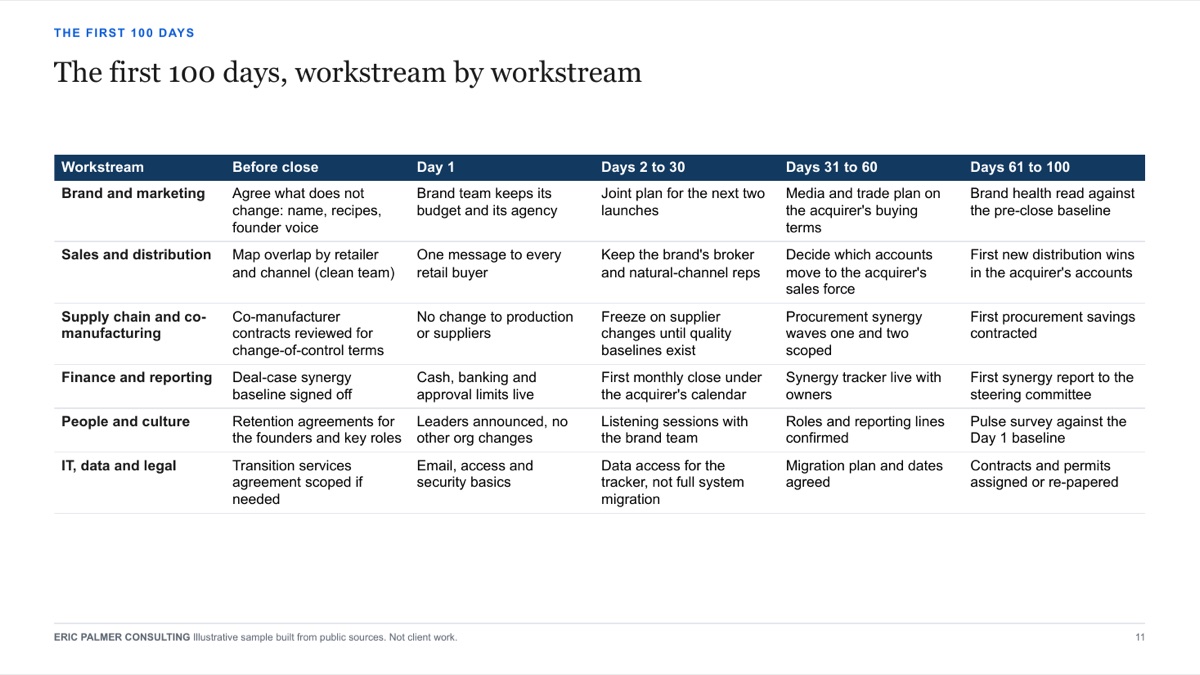
See a sample integration plan (PDF, 21 pages) →
Illustrative sample, built from public sources for a hypothetical company. Not client work.
How I work a deal
- Sourcing
Founder relationships, and companies tracked to growth thresholds, often ahead of a process.
- Thesis
Each target tied to the growth plan and the portfolio gaps. Buy, build or partner.
- Diligence
Screen wide, go deep on a few, and meet management in person.
- Valuation inputs
The growth, synergy and positioning assumptions behind the models.
- Structure
Acquisition, joint venture or partnership, chosen deal by deal.
- Integration
Systems and reporting, manufacturing, distribution and sales, run to a written plan.
Related
Consumer brand acquisition screen →First 100 days integration plan →Integration planning →